Choosing window tint can be confusing. One film advertises high infrared rejection, another highlights UV protection, and another promises a darker shade. But which figures actually help you understand how comfortable your car will feel?
The answer starts with understanding four terms: TSER, IR, UV and VLT. Each tells you something different about a window film. Looking at them together gives you a clearer picture than relying on one impressive percentage.
Understanding sunlight: more than visible light
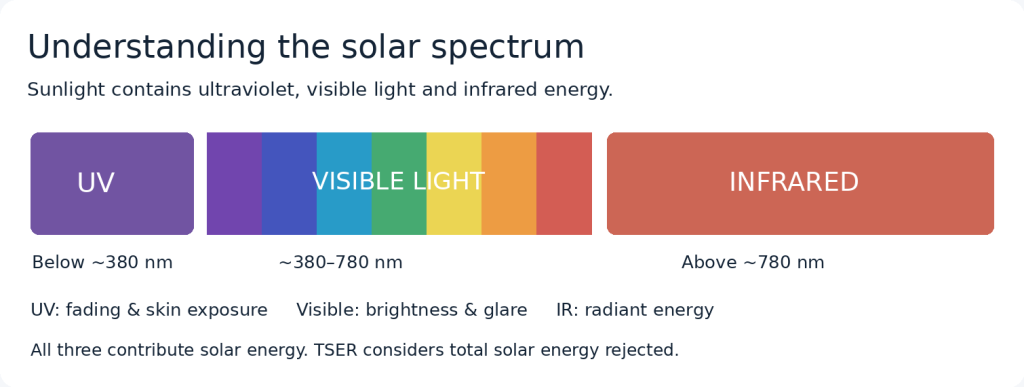
Sunlight contains three main components:
- Ultraviolet radiation (UV): invisible radiation associated with skin exposure and damage to interior materials.
- Visible light: the part of sunlight we can see, which affects brightness and
- Infrared radiation (IR): invisible radiation that carries energy and contributes to
All three carry energy. When sunlight enters a vehicle, that energy can be absorbed by seats, dashboards and other surfaces, warming the interior.
This is why effective heat control involves more than blocking infrared alone.
What is TSER?
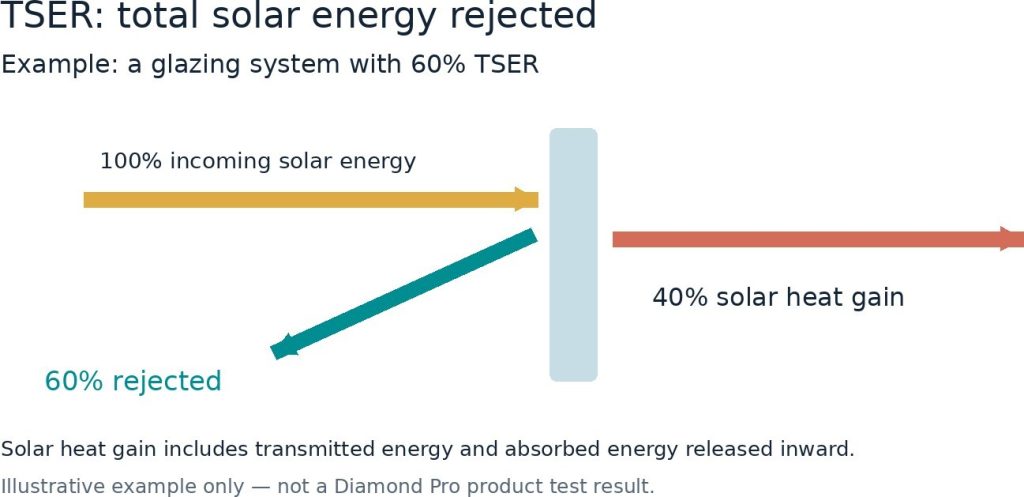
TSER stands for Total Solar Energy Rejected.
It describes how much of the total incoming solar energy a film-and-glass system prevents from contributing to heat gain inside the vehicle.
TSER considers the combined effect of ultraviolet, visible and infrared energy. It is therefore a useful overall measure when comparing solar heat rejection.
For example, a glazing system with 60% TSER rejects approximately 60% of the incoming solar energy, leaving approximately 40% contributing to solar heat gain.
That remaining heat gain includes energy passing directly through the glass, plus some energy absorbed by the glazing and subsequently released inward.
A 60% TSER figure does not mean your car will be 60% cooler. Actual cabin temperature also depends on factors such as sunlight intensity, glazing area, parking conditions and air-conditioning use.
Is TSER just a measure of visible light?
No. Visible light contributes to solar heating, but TSER accounts for energy across the solar spectrum.
A darker film may reject more energy partly because it transmits less visible light. However, darkness alone does not establish its overall performance.
For a fair comparison, look at films with similar light transmission and figures measured using comparable glass and testing conditions.
What is infrared rejection?
Infrared rejection describes how much infrared energy is rejected under the stated measurement method.
Infrared performance matters, particularly in strong sunlight. However, an IR percentage needs context.
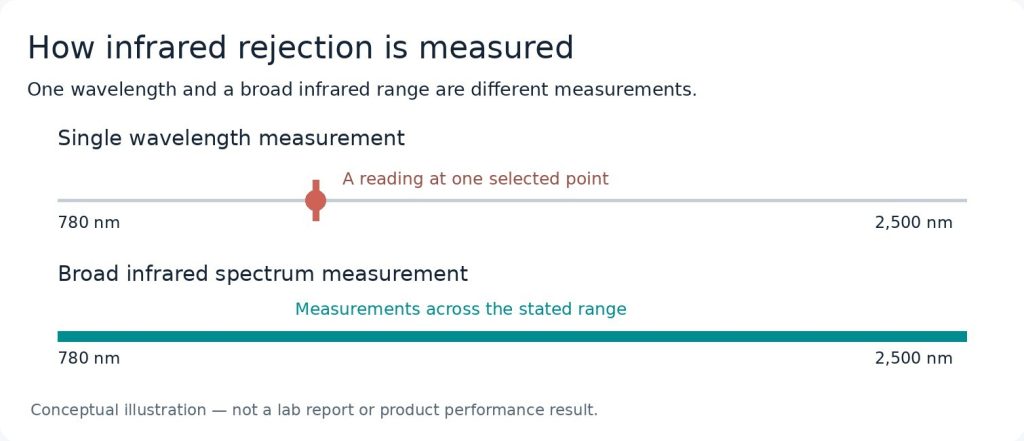
A claim such as “99% infrared rejection” may describe a measurement at one selected wavelength. It does not automatically mean the film rejects 99% across a broad infrared range – or 99% of total solar energy.
Single-wavelength versus broad-spectrum testing
A single-wavelength measurement checks performance at one point in the infrared spectrum.
A broad-spectrum measurement evaluates performance across a stated range. Depending on the method, those measurements may be weighted to reflect the energy present across that range.
These approaches can produce different results. A film may perform exceptionally well at one wavelength while performing differently elsewhere.
At Diamond Pro Films, our approach is to consider performance across the relevant infrared range rather than judge a film by a favourable wavelength alone. When comparing published figures, the measurement range and method should be clear.
A broad-spectrum figure still needs its range stated: it should not be assumed to cover every infrared wavelength.
What does UV rejection tell you?
UV rejection describes how much ultraviolet radiation the film blocks under the stated testing conditions.
UV protection matters because ultraviolet exposure can contribute to skin damage and the deterioration of interior materials.
However, high UV rejection is not the same as high overall heat rejection. UV represents only one part of incoming solar energy.
Two films can both offer high UV protection while providing different levels of solar heat rejection.
UV protection also does not prevent every cause of fading. Visible light, heat, material quality and exposure time can contribute too.
What is VLT?
VLT stands for Visible Light Transmission.
It tells you how much visible light passes through a material or glazing system.
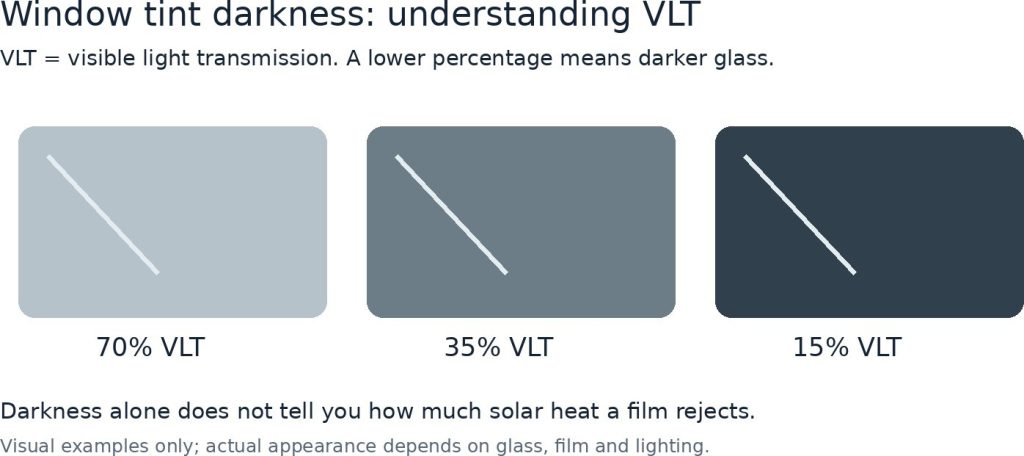
A higher VLT means more visible light passes through. A lower VLT means a darker appearance. For example:
- 70% VLT: allows more visible light
- 35% VLT: allows less visible light
- 15% VLT: produces a darker
Check whether a quoted figure refers to the film alone or the finished film-and-glass combination. The vehicle’s original glass affects the final result.
The Diamond Pro Films approach
Diamond Pro Films believes customers should understand what window-film figures mean.
That means considering total solar energy rejection alongside infrared performance, UV protection and visible light transmission.
It also means looking beyond a favourable infrared measurement point and asking how performance has been evaluated across the stated range.
Explore our Diamond Pro Nano Ceramic Window Tint to learn more about our automotive window-film range.